Star of Arkansas Helps Researchers Find New State of Material at the Nanoscale
Published on September 30, 2009
Using Star of Arkansas computational resources, researchers at the University of Arkansas and University of California-Los Angeles have discovered a new kind of quantum state of material at the nanoscale level that appears at low temperatures.Research professor Sergey Prosandeev and professor Laurent Bellaiche of the University of Arkansas and A.R. Akbarzadeh of the University of California-Los Angeles report the state, called incipient ferrotoroidics, in Physical Review Letters.
You can read more about the discovery here.
Arkansas Receives $3.3 Million Grant From National Science Foundation
Published on September 03, 2009
A new $3.3 million grant from the National Science Foundation which was made possible by the American Recovery and Reinvestment Act of 2009, will enable researchers at the University of Arkansas and other colleges and universities in the state to build and support cyberinfrastructure and to train students and workers in information-technology systems, tools and services.The grant, titled CI-TRAIN, or Cyberinfrastructure for Transformational Scientific Discovery in Arkansas and West Virginia, is part of a broader award to create a research consortium between the two states, which have researchers specializing in high-performance computing, visualization and modeling.
You can read the article in its entirety here.
Your College Gets a Supercomputer! And Yours, and Yours!
Published on August 11, 2009
An interesting article published this week in The Chronicle of Higher Education detailing the spread of supercomputing resources into academic institutions. Amy Apon is quoted and thorough mention of TeraGrid and the Campus Champions program are some of the highlights.You can read the article in its entirety here.
SC09 Education Workshop at The University of Arkansas-Fayetteville
Introduction to Computational Thinking
Published on August 07, 2009
During the week of August 2, the University of Arkansas hosted a workshop in the SC09 Education Workshop series entitled "Introduction to Computational Thinking". The purpose of the workshop is to introduce participants to and inspire them with new techniques, teaching materials, and applications to use computational models in the undergraduate curriculum. By bringing faculty from different disciplines together so that they can learn how to incorporate computational models into their classrooms and research projects, the workshop advances the use of computing in undergraduate science education.Topics for the workshop include various types of models and hands-on experience with particular tools. Lead instructor Bob Panoff provided scientific software examples and lab projects for the 35 attendees representing more than 20 educational institutions, twelve states, and seven countries.
Computer lab accommodations for the workshop were provided by the Walton College of Business. Local arrangements were facilitated by the University of Arkansas Global Campus and the Arkansas Research and Education Optical Network.
You may view a video of the morning's lecture from August 3.
Information about future workshops and training opportunities with the SC Education program are available at the SC Education website
Signing of the Arkansas Cyberinfrastructure Task Force Act
Published on April 06, 2009
The state of Arkansas is making
history as Governor Mike Beebe signs into law the bill that creates
the Arkansas Cyberinfrastructure Task Force on Tuesday, April 7.
The Arkansas Cyberinfrastructure Task Force Act, sponsored by Rep.
Jon Woods, raises the importance and visibility of cyberinfrastructure
in the state of Arkansas. Cyberinfrastructure
means shared high performance
computing, data storage systems, data repositories, advanced
instruments, data center facilities, visualization environments, and
people, all linked together by software and an advanced statewide
optical network to improve and enable breakthroughs not otherwise
possible.
In signing this bill into law, Governor Beebe and the state of
Arkansas recognize that the implementation and sustainment of the 2008
Cyberinfrastructure Strategic Plan and associated policy development
for cyberinfrastructure is crucial to the future of Arkansas and its
citizens. The Arkansas General Assembly is
positioning itself to
consider both near term and strategic goals in its deliberations. The
state will benefit from an improved understanding of
cyberinfrastructure and the recommendation of cyberinfrastructure
policies to leverage technology investments in order to energize the
economic development of the state, and to evolve cyberinfrastructure
for the benefit of education, research, and job creation.
Arkansas
has already made significant strides in the creation of shared
cyberinfrastructure. The University of Arkansas and all of
the state’s
four-year public universities will soon be connected to the Arkansas
Research and Education Optical Network, ARE-ON, a high-speed
fiber-optic-based Internet communications network. ARE-ON will expand
research, academic, health care and emergency preparedness capabilities
throughout the state by providing the universities access to national
and international high-speed Internet networks such as the National
LambdaRail and Internet 2. The Arkansas High Performance
Computing
Center was established by funding from Governor Mike Beebe through the
Arkansas Science and Technology Authority (ASTA) in 2008 to serve as a
core resource for the development of competitive research throughout
the state of Arkansas and for economic development benefit.
The
combined power of the Arkansas High Performance Computing Center and
ARE-ON will take the state of Arkansas to the next level in the global
economy.
The ARE-ON web site is http://www.areon.net/
The Arkansas High Performance Computing Center web site is http://hpc.uark.edu/
The 2008 Arkansas Cyberinfrastructure Strategic Plan is available
on the website of the Arkansas Research and Education Optical Network
at http://areon.net/resources/CyberinfrastructureStrategicPlan20081024.pdf
The text of HB2011 is available at http://www.arkleg.state.ar.us/assembly/2009/R/Bills/HB2011.pdf
You can read more about cyberinfrastructure and research activities in
Arkansas that utilize cyberinfrastructure at http://areon.net/resources/UAMS.pptx
Arkansas High Performance Computing Center Welcomes New Associate Director for High Performance Computing Operations and User Support
Published on April 03, 2009
The Arkansas High Performance
Computing Center welcomes Dr. David Chaffin as the new associate
director for
high performance computing operations and user support.
Chaffin joins the
center from Texas Tech University where he has worked in HPC operations
and
user support for about ten years. He was at Los Alamos
National Labs
prior to that. Chaffin holds a Ph.D. in Engineering Sciences
from the
University of Tennessee.
Chaffin has also been appointed as a research assistant professor in
the
mechanical engineering department. He brings to the
University
several years of experience in working with researchers on high
performance
applications. If you are interested in finding out more about
how your
code can run on the university's supercomputer, the Star of Arkansas,
please
contact David at dchaffin@uark.edu.
The Arkansas High Performance Computing Center is directed by Amy Apon,
professor of computer science and computer engineering. Jeff
Pummill, Senior Linux Cluster Administrator, also serves as TeraGrid
Champion for the
Arkansas HPC Center.
Student Awards and Honors
Published on January 13, 2009
A poster presented at the Fall MRS meeting by Rahul Rajgarhia, a mechanical engineering doctoral student (co-advised by Ashok Saxena, dean of the College of Engineering, and Doug Spearot, assistant professor in mechanical engineering), was selected as one of the best posters for the Symposium W: Computational Materials Design via Multiscale Modeling and was awarded a cash prize.This work has been invited for publishing in the Journal of Materials Research. Below is the abstract and title of the poster:
The Plastic Deformation Behavior of Single Crystal and Nanocrystalline Copper Doped with Antimony.
Rahul K Rajgarhia, Douglas E Spearot and Ashok Saxena; Mechanical Engineering, University of Arkansas, FayettevilleMolecular dynamics simulations have been used to study dislocation nucleation under constant tensile strain in single crystal and nanocrystalline copper with varying concentrations of antimony (0.0-2.0 at.%). In low concentrations, antimony does not form clusters or precipitates in copper and completely segregate to grain boundaries. Therefore for the initial configuration, antimony atoms were randomly distributed in the single
crystal model. It was observed that the strained regions around the antimony atoms act as sources for partial dislocations and the maximum stress decreased with the increasing concentration of antimony. In the nanocrystalline model, antimony atoms were preferentially located at grain boundaries and the effect of grain size and antimony concentration will be discussed. The ultimate goal is to understand the underlying mechanisms involved with plasticity in Cu-Sb to fabricate a Cu-Sb nanocrystalline alloy with superior mechanical properties.
Rahul referenced the Star of Arkansas as being a crucial element in his research.
The Star of Arkansas is #339 on Top500!
Published on June 18, 2008
The Star of Arkansas is officially ranked 339 as one of the fastest supercomputers in the world! The Star of Arkansas has a sustained performance of 10.75Teraflops (trillions of floating point operations per second) and joins only 33 entries from other academic institutions in the United States on this list.The fastest computer in the world is Roadrunner, at Los Alamos National Laboratory. This supercomputer is the first one to ever have a sustained performance of more than 1 Petaflops (1000 Teraflops). The performance of the #500 supercomputer is 9Teraflops.
The newest list was published June 18, 2008 at the International Supercomputing Conference in Dresden, Germany. For more information please visit http://www.top500.org/The Star of Arkansas Goes Into Full Production!
Published on May 27, 2008
The Star of Arkansas was made available for general production
use on Wednesday, May 21, 2008. Star is approximately eight
times more capable than our first supercomputer, Red Diamond.
Up to 93% of the available compute nodes are being utilized by
applications from computational researchers from the University of
Arkansas and jobs are waiting for resources. Jobs have been
submitted by users from four different departments from two colleges on
campus.
The amount of computing accomplished on the Star of Arkansas during its
first five days of production operation exceeds the amount of computing
that can be accomplished on Red Diamond during an entire month!
On May 21, 2008, the Star of Arkansas ran the largest parallel user
application ever to have run on a supercomputer in Arkansas.
Sergey Lisenkov, Research Associate in the Department of Physics, ran a
job across 1240 cores before we opened the queue to general
submissions. His job used 15224.84 seconds of user time and
1.360000 seconds of system time. This job would have taken at
least one year to complete as a serial application, but it completed
overnight on the Star of Arkansas!
Another user, Stella Huff, Ph.D. candidate in the Department of
Chemistry and Biochemistry, has run applications over a three day
period that would have taken three weeks to complete on Red Diamond.
For more information about the Star of Arkansas and access to High
Performance Computing resources at the University of Arkansas please
send email to the Senior Linux Cluster Administrator, Jeff Pummill <jpummil@uark.edu>.
University of Arkansas Installing Supercomputer; 'Star of Arkansas' to Be State's Fastest
Published on March 1, 2008
Scientists and engineers at the University of Arkansas will soon be able to conduct complex research projects using a new supercomputer system, dubbed the "Star of Arkansas." Once it is installed later this spring, the Star of Arkansas will be the fastest and most powerful computer in the state, allowing researchers to design vastly more complicated experiments, models and simulations than previously possible. The supercomputer will let scientists and engineers push the boundaries of knowledge in subjects ranging from bird flu to weather prediction.
The purchase of the Star of Arkansas was funded in part with an $803,306 grant from the National Science Foundation, with substantial matching funds from the University of Arkansas, and in partnership with Dell Corp. The supercomputer arrived on campus on Feb. 5, and Dell technicians will install the system later this month. The university's high-performance computing staff and researchers will then spend several weeks testing and evaluating the system.
"Science has reached the point where the key discoveries are possible only by studying extremely complex systems," said Amy Apon, who directs high-performance computing at the university. "These discoveries increase knowledge, of course, but they also fuel economic development. The Star of Arkansas is essential to the future of both the university and the state of Arkansas."
Stan Ahalt, executive director of the Ohio Supercomputer Center, recently served as an external adviser to the state of Arkansas in the area of the resources and the personnel needed to support supercomputing in the state.
"Computer simulation and modeling, using computers like the Star of Arkansas make the impossible possible," said Ahalt. "These techniques give scientists the opportunity to 'see' and study things that cannot otherwise be seen or studied."
For example, some things are too small, such as molecules, atoms, or quarks; others, too large, like galaxies or even the universe. Some processes, like photosynthesis are too fast, while geological processes, for example, are too slow. Weather and climate are too complex to study except with computer simulation, while experiments involving toxic materials, viruses or earthquakes are a lot safer when scientists use a computer model instead of the real thing. No scientists would be allowed to experiment with actual economies or traffic systems, but they can try anything with a computer simulation, without harming anyone in the real world. Finally, most researchers don't have access to a multi-billion dollar particle accelerator, but with a supercomputer they can simulate the outcomes.
"Practically speaking," said Ahalt, "the Star of Arkansas has the potential to improve Arkansas' economic future through research in areas such as natural gas production, bird flu prevention, rice irrigation, nanotechnology, large-scale transportation and commerce systems, material design, sustainability, and personalized medicine."
The Star of Arkansas is the university's second supercomputer. The Red Diamond supercomputer was installed in 2005, and will continue to be available to researchers. The Star of Arkansas is approximately 8 times faster than the earlier supercomputer, and can hold more than five times the amount of data stored in the entire Library of Congress.
Like Red Diamond, Star will be connected to the Arkansas Research and Education Optical Network, making it accessible to scientists and engineers in Arkansas and the region to collaborate with university researchers. In addition, the supercomputer and optical network enable collaborative courses in high-performance and grid computing, as well as seminars and academic courses, attracting new users and building computational expertise in the region. The Star of Arkansas will also be used to teach undergraduate and graduate students how to perform complex modeling and simulations.
The names, Star of Arkansas and Red Diamond, were chosen as symbols of the state of Arkansas in the realm of new discoveries in science and engineering. Arkansas is the home of the world's only public diamond mine and the eighth largest diamond repository in the world. The Star of Arkansas is the name of one of the largest diamonds found in the state. The color red represents both the University of Arkansas school colors and the Arkansas state flag, which boasts a diamond on a red background.
Video of the Star of Arkansas being delivered to the University of Arkansas can be viewed on You Tube at http://www.youtube.com/watch?v=Ki8zQu6R7SA .
Technical information
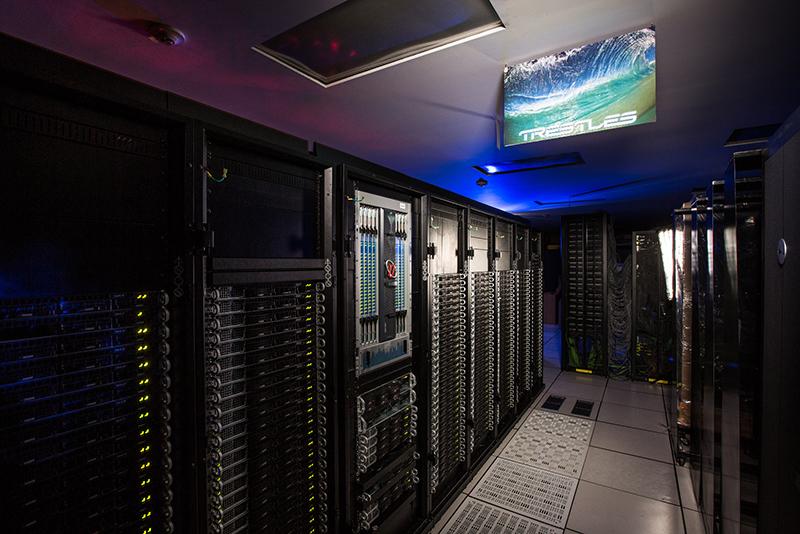
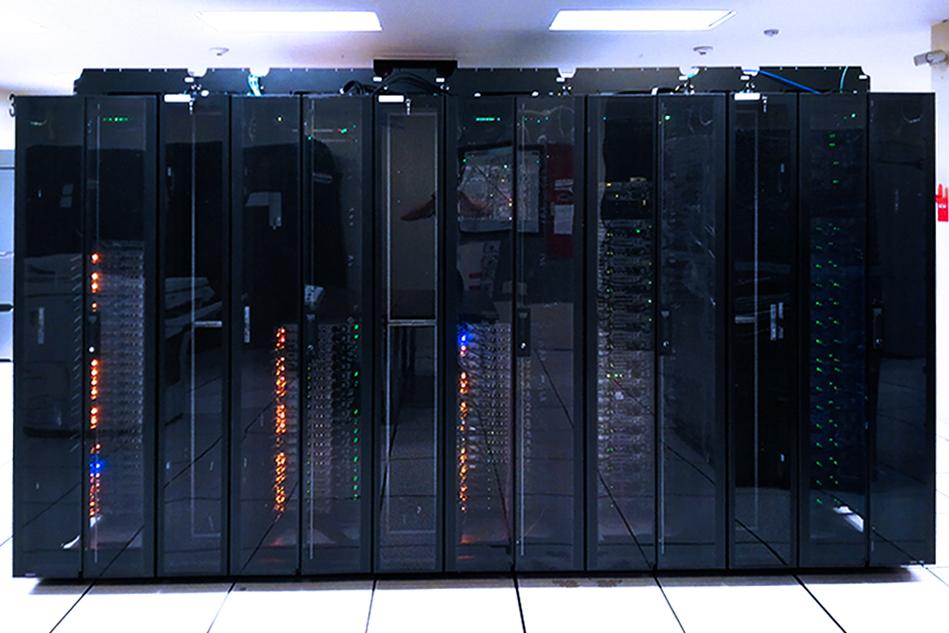
The Star of Arkansas supercomputer is built from 157 compute nodes, each with dual quad-core Xeon E5430 processors, 2x6MB cache, 2.66GHz, 1333FSB. There are a total of 1,256 cores, and each core has 2GB of memory. Performance on supercomputers is measured in "flops," or floating point operations per second. The theoretical peak performance of Star is 13.36Tflops, or 13.36 trillion floating point operations each second.
In comparison, Red Diamond has 256 cores and a theoretical peak performance of 1.638Tflops, with a measured sustained performance of 1.349Tflops.
The Star of Arkansas supercomputer is interconnected with an InfiniBand network that runs at 10Gbps, or 10 billions bits of information every second. The IB switch is from Qlogic and has expansion capacity up to 256 slots, of which only about 160 are used in the current configuration. With this switch additional compute nodes can be purchased incrementally and added to the cluster as additional hardware funds become available. The cluster is interconnected with an additional Gigabit Ethernet network for NFS access, and another Gigabit Ethernet network for management.
The Star of Arkansas has two file systems to handle computational and data-intensive applications. The NFS file system will be used for permanent storage and consists of 4TB of raw disk storage, or more than 4 trillion characters of data. The Lustre file system is used for fast temporary storage. The storage for Lustre comes from Data Direct Networks and includes 21 TB of raw disk storage. In addition, 50 nodes have local storage of 1TB, and 107 nodes have local storage of about 320GB, more than 320 billion characters of data. The total amount of storage potentially available on Star is more than 109TB. In comparison, the Library of Congress has estimated that it stores 20TB of text.
Contact:
Amy Apon, Professor, Computer Science and Computer Engineering
College of Engineering
(479) 575-6794, aapon@uark.edu
Jeff Pummill, Sr. Administrator, High Performance Computing
Graduate School
(479) 575-4590, jpummil@uark.edu
Reference Article: UofA College of
Engineering Web Page
Arkansas Joins the Coalition for Academic Scientific Computation
Published on December 10, 2007
The University of Arkansas is taking another step in its
committment
to high performance computing by becoming the newest member of the
Coalition of Academic Scientific Computation (CASC). CASC is
an
organization of leading academic institutions with the mission of
promoting the use of high performance computing and communications
technology to increase national competitiveness, improve workforce
training, advance economic development, and enhance education.
By joining CASC, the University of Arkansas joins 50 peer institutions
in its promotion of supercomputing, or the use of computational tools
and techniques for scientific discovery and innovation. A
recent article
in the Washington Post emphasizes the importance of fast
computers for scientific discovery and innovation.
Supercomputers are a tool that make science possible that would
otherwise be impossible, from the understanding of the smallest of
possible materials, such as those found in the study of nanotechnology,
to the understanding some of the largest and most complex processes in
our universe, such as those found in global climate change.
For more information about CASC visit the website at http://www.casc.org/
The complete list of CASC members is available at http://www.casc.org/members.html
New NSF Grant for Supercomputer
Published on September 17, 2007
The University of Arkansas has received an $803,306 Major Research Instrumentation grant (MRI #072265) from the National Science Foundation to purchase and assemble the university's second supercomputer. The new machine will be among the fastest supercomputers in all U.S. academic institutions.
The computer will enable new and ongoing projects in computer science, physics, chemistry and other areas. Perhaps more importantly, by connecting to networks and other high-performance computers, the supercomputer will significantly augment the state's computing infrastructure and facilitate collaboration among researchers at other institutions within the University of Arkansas System.
Although many technical specifications have not yet been determined due to the possibility of harnessing imminent and significant improvements in computer-processing technology, the new machine will operate at a speed of at least six teraflops, approximately four times faster than Red Diamond, the university's first supercomputer.
Last updated: August 11, 2009